We will be closed from December 22nd - January 9th. Merry Christmas & Happy New Year!

How to Insulate an Old House: The Complete Guide

old house

Old homes are often beautiful and filled with period features like elegant doors, windows and fireplaces. 

Unfortunately, the price you pay for these features is often dealing with draughts, poor temperature regulation and excess moisture. 

Structurally, you can also find your roof, walls and floor to be seriously lacking in their temperature control abilities. 

These issues can quite literally put a dampener on how you enjoy your home. Read on to find out how to insulate an old house. 

Why Insulating an Old House is Important

While old houses may have character, they also have shortcomings. Modern building standards, such as minimum R-Value requirements, were not commonplace in past decades. If your house is old enough, they may not have even been invented yet!

Read our complete guide to R-Values. 

While old houses are known for their sturdiness, things like insulation and proper finishing and sealing are often absent. 

If you’re routinely throwing an extra log into your vintage fireplace, all of that extra heat is just compensating for the cold air that is entering your home. 

Paying to insulate your old house will save you money in the future by limiting how much you need to rely on other heating sources. It will also make you much more comfortable and able to enjoy your home. 

Doors, Windows and Fireplaces

In old houses, when things like doors, windows and fireplaces were installed the owners were more concerned with how they looked than how they functioned. Because of this, they aren’t as well fitted or sealed compared to their modern day equivalents.

Have your doors and windows assessed to see if they are letting in draughts. Often the frames of wooden sliding windows will have worn down since they were installed and draughts can easily filter through the gaps. Fireplace chimneys are another common culprit for unwanted cold airflow, with gaps often leading into the roof cavity or the living room itself.

Getting any gaps or holes fixed should be your first priority. You’ll be amazed by how quickly it makes a difference!

The Roof

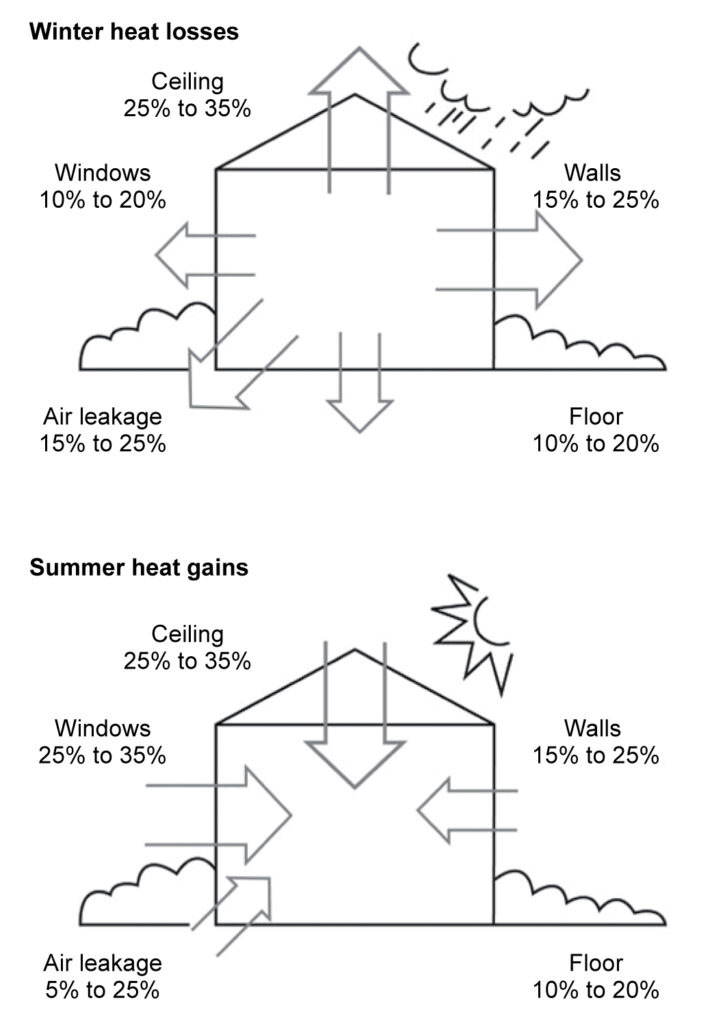
Up to 35% of a house’s total heat loss is through its roof. In old houses, this problem can be made worse by deteriorating materials and larger cavities.
Australia’s climate is hot, so modern homes are built with small roof cavities to reduce the amount of space for hot air to collect. In England, however, regular snowfall makes pitched roofs (pointed rather than flat surfaces) necessary. 

Much of Australia’s late 1800’s/early 1900’s infrastructure was still being built to reflect an English pitched style. If you have an old home with a pitched roof, you need to insulate it. 

In winter and summer, this cavity will fill with cold and hot air respectively. If the materials on your roof are worn with age, there could be gaps leading from the cavity to the interior, or from the cavity to the outside air. Both of these issues will make living in your old house uncomfortable. 

The following insulation materials will fix your issue:

  • Woolcell
  • Polyester 
  • Fibreglass

Woolcell pump in insulation is the most effective choice. As its name suggests, it can be pumped into your roof cavity without needing a person to physically gain access and install it. Once it settles, it will fill any gaps and create a breathable blanket that is great for preventing moisture buildup that is common in old houses. 

The Walls

Now that the roof is insulated, it’s time to turn your attention to the walls. Your walls can lose up to 25% of your house’s heat. Even if you have insulated your roof, 25% is significant and will still be noticeable. . 

The issue with insulating walls in old houses is the process is radically different depending on whether or not the wall has a cavity. 

Many older homes don’t have wall cavities, as they didn’t become commonplace until later in the 1900’s. To check, you can examine your brickwork. If all of your bricks are horizontal, you likely have a cavity. If some of them only show the end of the brick, you likely have a solid wall. 

To be certain, you should get a professional to inspect your walls. 

Wall Does Have a Cavity

If the wall does have a cavity, there are a number of solutions, including:

  • Insulbloc
  • Rockwool Pump-In Fibreglass
  • Batts

Insulbloc is an insulation material made from small polyester cubes that can be pumped into wall cavities through small, discrete holes. These cubes settle to form a strong protective barrier against the cold outside air, and they don’t cause any visible damage that could jeopardise the heritage listing or character of your old house. 

The Floor

With the roof and the walls insulated, there is just one surface left before your old house is toasty warm – and you’re standing on it!

Approximately 20% of your house’s heat is lost through its floor. Because the floor is the surface that you actually stand on, it’s one of the most important places to insulate. No one wants cold feet on a chilly winter morning!

Much like the walls of an old house, there are two kinds of floors, each with different insulation processes. 

Floor Does Not Have a Cavity 

If your floor doesn’t have a cavity it can be insulated, but the process is very disruptive and expensive. You will need to hire professionals who will raise your floor to create a cavity. This cavity will then be insulated with polyester batts. 

This process will rip up your floor and cost you living space because your new floor will be higher than your old one. Not to mention, floors without a cavity are less likely to need insulating since there is no room for draughts to travel underneath. This option should only be considered as a last resort. 

Floor Does Have a Cavity

To insulate a floor with a cavity, professional installers simply have to measure the distance between floor joists and fit your polyester batts between them. This is non-destructive and doesn’t take long. You can have your old house feeling as snug as a modern one in no time. 

4 Seasons Insulation

Old houses are fantastic for letting you enjoy classic styles and features from the past, but they can also come with their fair share of issues.

By insulating the roof, walls and floor of your old house (where applicable), you can make sure that the cold air stays where it belongs – outside!

4 Seasons Insulation are experts at insulating any kind of home, old or new, and offer a range of insulation varieties and solutions. 

For a free measure and quote, get in touch with us today!

Explore our Central Coast services:

Explore our Sydney services:

Explore our Newcastle services:

The Top 5 Benefits of Underfloor Insulation

Underfloor insulation slippers

Did you know that roughly 20% of a home’s heat is lost through its floor?

When most people think of insulation, they think about the walls and roof of a home. But underfloor insulation is essential for maintaining a stable, comfortable temperature.

What is Underfloor Insulation?

In principle, underfloor insulation works the same way as regular insulation. It still involves creating a barrier between the temperatures outside your home, and the desired temperature inside your home. 

The main difference is wall and roof insulation contend with elements like rain, wind and direct sunlight, while underfloor insulation must protect against the cold and moisture of the ground, as well as underfloor draughts. 

Insulation can be installed in cavities beneath elevated floors and is a great way to keep your home warm.

Learn more about how insulation works.

The Top 5 Benefits of Underfloor Insulation

If you are considering installing underfloor insulation, here are the top 5 benefits that will help you make your decision.

Prevents Cold Airflow Through the Floor

A cold floor is more immediately noticeable than a cold wall or roof. No one likes to get out of bed on a chilly winter morning and put their feet on freezing tiles or floorboards. Unfortunately, floors are the one surface in a house that you can’t avoid touching. 

Underfloor insulation can keep your feet warm in winter by sealing up gaps where draughts, chilled by the cold temperature of ground, seep into your home. 

Lowers Energy Costs

If your home is uninsulated, you have to heat it artificially using a heater or a fireplace. By installing underfloor insulation, you can get away with heating your home less often because the inside temperature will naturally be higher. 

The one-off price of installing underfloor insulation will also pay itself off over time by reducing the cost of electricity, gas or firewood.  

Learn more about how insulation reduces your energy expenditure. 

Lowers Environmental Impact

Reducing your reliance on artificial heating saves you money, but it also saves the environment. For people looking to limit their carbon footprint, insulation is a smart investment. 

Imagine the energy you could save if you didn’t need to rely on heaters during winter? This is especially true of smaller electric heaters, which don’t create much lasting warmth and have to run continuously for any benefit. They require much more energy than most people realise, and it really isn’t worth the temporary warmth they provide. 

Protects Against Moisture

Whether your home has an underfloor cavity or not, moisture can be a serious problem. 

If you have an uninsulated underfloor cavity, there is nothing to prevent damp, moist air from entering your home. This air is cold and will make your home much less comfortable. 

Reduces Sound

An often unknown or overlooked benefit of insulation is sound-proofing. The ground carries soundwaves which travel through unsealed floors and up into your house. If you live in a place with a lot of noise, especially from high traffic, underfloor insulation will muffle it before it can disturb you.

4 Seasons Insulation

While underfloor insulation is an excellent way to see instant improvement, for a truly comfortable, warm home, you’ll want all of your surfaces to be insulated. 

With your floor, walls and ceiling all working together, your living area will have full protection from the elements.

At 4 Seasons Insulation, our experts can assess your home and offer the perfect solutions to keep you toasty warm during the winter months. 

For more information, visit our website. 

If you’re tired of cold feet (pun intended) and have decided to insulate your home, contact us for a free quote today. 

Check what we offer in Central Coast services:

Check what we offer in Sydney services:

Check what we offer in Newcastle services:

Insulation R-Value: A Complete Guide

Room with insulation and a ladder

Despite our best efforts to use energy wisely and maintain a stable temperature, without proper functioning insulation our home’s ability to regulate the inside environment is compromised. 

This results in sweltering temperatures in summer, and freezing conditions in winter. 

Your home’s ability to maintain temperature can be measured, and that measurement is known as its ‘R-Value’ or sometimes ‘R-Rating’. 

What is insulation?

To understand R-Value, you first need to understand what insulation is and how it works. Insulation is the material that blocks airflow from escaping or entering your home. It is effective at blocking hot air from entering during the summer, and escaping during the winter, so it is an important part of your home’s heating and cooling systems no matter the weather. 

There are different types of insulation that can work best in different climate types, and an insulation expert can help you understand your needs and your options for insulation, helping combat any other heating or cooling problems in your home that an expert may identify.

What is an R-Value?

Insulation R-Value specifically measures how well your home’s insulation resists conductive heat flow. There are a few main factors that contribute to the overall R-Rating, including: 

  • The insulation material
  • Your home’s location and average temperature
  • The lifespan of your insulation material and how old it is
  • The moisture level in your home
  • Quality of installation

R-Value can be an important factor in determining your insulation decisions because a high insulation R-Value will not only keep your home warmer in winter or cooler in summer, but it will also save you money on your electricity bills because your home won’t have to rely on air conditioning or other systems. 

Why is my home’s R-Value important?

Without proper insulation, your home can lose a significant amount of warmth in winter, and gain heat in summer, which ultimately costs you money. Your heating and cooling systems need to work harder to combat escaping air and maintain the temperature. You can reduce your electricity bill significantly just by paying attention to your insulation, and your home’s R-Value.

Savings don’t just come in the form of decreased energy bills when you insulate your home with R-Value in mind. You will also find that you need to repair your heating and cooling systems less frequently since they won’t need to work as hard to heat and cool your home.  

What can I do to increase the R-Value of my existing home?

Increasing the R-Value of your home is still possible in your existing home with a few small renovations. The most effective way to do this is by installing thicker and better-quality insulation, or topping up your existing insulation. This creates more substantial barriers and prevents heat from escaping, but there is one notable exception to this rule. 

This is where quality installation becomes an important factor. If your installer understands where insulation is best placed within your home and can utilise techniques such as the principle of “thermal bridging” where insulation is placed near joists, studs, and other heat-conducting building materials, then your home’s R-Value will increase.

Using Passive Design To Further Improve Energy Efficiency

When your home is specifically designed for the climate you live in, there should be little need for electric heating and cooling units. This type of home design is called ‘Passive Design’, and it can save you thousands on your electricity bill. 

Using natural heating sources, orientation, thermal mass, and importantly, insulation, you can take advantage of the natural climate of your area and minimise heat loss or gain. Passive Design is best applied to new builds, but if you have an existing home, renovations can go a long way towards creating a passive design in your home. 

In Australia, there are eight different climate zones, and passive design is going to look different depending on which of them you live in. Passive design is a hugely expansive idea and deserves an article all of its own, but we will go through the two most relevant concepts here; passive heating and passive cooling.

Passive heating

Passive heating is used often in cooler climates and works to allow winter sun into your home while keeping existing heat inside. If you live somewhere that’s very cold in winter but also can get quite warm in summer, then it’s important to balance passive heating design with passive cooling design to maximise benefits in both potential climates. 

Passive cooling

Passive cooling encourages airflow and evaporative cooling to keep your home cool in warmer seasons and climates. 

For both of these strategies, insulation is a key factor in ensuring passive design. Ensuring you use the correct insulation type for your climate and passive design goals will be critical, as will ensuring placement is correct. 

Another type of insulation that is important to facilitate passive design is window glazing. Windows and doors bring in or let out significant airflow, and will need to be treated to ensure they are working with your passive design goals, and not against them. Different types of glazing will work for different climates and home orientations. 

Conclusion

A home that utilises both smart insulation and passive design strategies is going to regulate temperature far more effectively, allowing its R-Value to soar. With the help of experts, you can ensure that your home is built to work with your local climate rather than against it. 

If you are looking to improve your home’s R-Value by replacing or installing insulation, get in touch with our team today! We are your local experts and can ensure that you have the right insulation for your climate, helping you save on heating and cooling. 

Explore what’s available in Central Coast services:

Explore what’s available in Sydney services:

Explore what’s available in Newcastle services:

Minimum Insulation R-Values For Australian Homes

Sunlight coming into insulated attic

There’s nothing worse than sitting at home on a sweltering hot summer’s day and feeling every sweat droplet roll down your face. On the flip side, the last thing you need is to be walking around your home in winter with blue lips and chattering teeth. 

You want the outside weather to do just that – stay outside. That’s where insulation comes into the picture, preventing those sweat droplets and blue lips before they even form. 

A well-insulated home offers year-round comfort. You’ll find yourself reaching for that air-conditioning button far less and enjoying the natural refuge your home creates all on its own. 

Are you curious about how insulation works? We have all the answers you need to live in comfort day in and day out.

What is insulation?

Insulation is a material you can use in your home to resist or block the flow of heat energy. Put simply, in summer, you can use insulation to prevent the heat from outside entering your home. During winter, you can keep any heat you have inside from escaping out. It’s the perfect barrier to create year-round comfort you can rely on.

Types of insulation – and how they work

How your insulation works all depends on what type you opt for. When it comes to insulation products, you’re looking at two main categories: bulk and reflective. These can also be combined into a composite material.

At 4 Seasons Home Insulation, we only sell materials that meet Australian Standard AS/NZS 4859, Materials for the thermal insulation of buildings.

Heat can be transmitted in three different ways: 

  • Convection: the way heat circulates through liquids and gases
  • Conduction: the way heat moves through materials
  • Radiation: heat that travels in a straight line

Bulk insulation deals with the former two, while reflective insulation caters to the latter. As you might expect, composite insulation aims to offer the best of both worlds and block out as much heat as possible.

Bulk insulation

Bulk insulation is made from low-density materials and generally uses pockets of trapped air to prevent the transfer of convected and conducted heat. It works well in both ceilings and floors, trapping the heat in when it’s cold, and preventing it from entering when it’s warm. It can include:

  • Cellulose fibre pump in materials
  • Polyester batts
  • Fibreglass batts including rock wool
  • Rock wool pump in materials

Reflective insulation

As the name suggests, reflective insulation works by reflecting radiant heat, and is commonly used in the hotter parts of Australia. It uses a layer of foil backed by paper or plastic to bounce the heat back, away from your home. This style insulation relies on an air layer at least 25mm next to the surface. Materials include:

  • Foil faced blankets or sarking
  • Foil faced boards
  • Multi-cell foil products

Choosing the best insulation

As you might expect, not all insulation is created equal.

If you’re looking to compare different types of insulation on the market, then you need to understand its R-value. The higher this value, the higher the level of insulation. This value is determined by the type of insulation, its thickness and its density.

Your home is made up of the roof and ceilings as the outer walls. Each of these materials possess their own heat resistance (R-value). By adding the R-value of each of these components, you can determine the total R-value for your home.

The NCC and BASIX (in New South Wales) set out the minimum requirements when it comes to R-values for materials. Ideally, you want to set your sights higher than this for complete comfort in your home. Use it as a baseline, not as the standard.

Is insulation worth it?

The answer to this question is going to rely on a number of varying factors, including: 

  • It is an essential component to New Builds (BASIX Requirements) in Australia
  • Energy savings (less reliance in heating and cooling)
  • The environmental impact
  • Comfort
  • Health
  • Where you live and what the climate is like
  • How much time you spend at home

The simple answer is yes: insulation acts as a barrier to your home, keeping it nice and warm in winter and cool in summer. Properly insulating your home reduces heating and cooling costs, while also improving comfort. No more breaking out the icepacks or bringing your hot water bottles to bed. 

Without insulation, you’re allowing any artificial hot or cool air you create in your home to simply escape straight back outside, while also allowing the outdoor temperatures to creep inside. 

Good insulation regulates the temperature and keeps your fingers off that air-conditioning remote.

Finding the right insulation

Investing in the right insulation for your climate significantly reduces your heating and cooling costs – saving your valuable pennies. In fact, insulation is now mandatory in new builds, which makes sense since it’s cheap and will pay itself back in no time.

However, getting your hands on the right product isn’t enough. It needs to be installed correctly to perform well and avoid condensation problems. 

The effectiveness of your insulation is also dependent on where and how it is installed. For example, insulation that is flattened, won’t provide its full rated R-value. 

You also need to be aware of any thermal bridging in your home. These are pathways created by the building frame and allow heat and cold to travel through. Thermal bridging can be minimised with the right tools and expertise on hand, to ensure you receive the most effective insulation.

That’s where 4 Seasons Home Insulation comes in – we have over 30 years experience in installing insulation correctly. If you’re looking for more information or would like to arrange a quote, fill out a contact form today.

Get familiar with our Central Coast services:

Get familiar with our Sydney services:

Get familiar with our Newcastle services:

You Can Count On Pump-in Woolcell During An Insulation Supply Crisis

You Can Count On Pump-in Woolcell

It’s no wonder they’re shouting the name Woolcell from the rooftops.

That’s because this Australian-made, pump-in material is helping to keep the home insulation industry thriving – and Aussie homes comfortable all year round.

But what has led to this uptick in demand?

Well, Australia is in the grip of a supply shortage when it comes to home building and renovation materials at the moment, and this includes home insulation products.

Supply chain delays for some products are being held up for as long as 26 weeks – and insulation batts and other insulation materials are affected because of this.

Materials are in high demand worldwide due to the fact that many countries are using construction to stimulate their economies. This in turn is driving up costs.

The Suez Canal blockage, too, has caused shipping costs to rise.

According to Tim Reardon, chief economist for the Housing Industry Association, new home construction has increased by 20% in the last 12 months. As a result, quality insulation products are in short supply.

But Woolcell is proving to be the perfect solution.

You Can Get Pump-In Woolcell Right Now

Woolcell is an Australian-made premium pump-in roof insulation material. 

Natural salts are used in making Woolcell (borax, and boric acid), plus it’s a product made from Australian wool and recycled paper. 

The wool keeps the overall material light and together, giving you 100% coverage.

It has fire retardant properties and it’s breathable, so the chances of mould are greatly reduced. This is good news for those who suffer from asthma or allergies. 

The Woolcell also soaks up harmful indoor air pollutants too.

It was even awarded a National Wool Invention Competition ‘Prize of Distinction’ and is CSIRO-tested, so it meets all necessary industry standards.

And, besides being environmentally friendly, it also offers a lifetime warranty.

Woolcell – Your Best Bet For Total Coverage

Regardless of the access restrictions, Woolcell can be installed inside flat roofs, cathedral ceilings, or between floors and roof pitches with very little effort; it is the ideal solution for areas where bulk insulation like batts cannot be installed.

The lack of gaps in Woolcell means that it is better for thermal and acoustic insulation. Woolcell is also less likely to suffer from moisture damage, and is less prone to vermin infestation. 

Woolcell has a superior R-value and is semi-bound, so it doesn’t require surface sprays to adhere, resulting in a long-lasting and stable product.

The Importance Of The ‘R-Value’

In the building and construction industry, the thermal resistance rating, or R-Value, is a measure of a material’s ability to resist heat transfer.

A higher R-Value means better thermal resistance. Units are measured in m2K/W.

R-Value = Thickness (m) / Thermal conductivity (W/mK)

Specifying insulation should take into account the thermal resistance of the material. 

Therefore, it is more economically efficient to increase the thickness of the product than to use one with a lower thermal conductivity in order to achieve a specific thermal resistance.

R-values for roof insulation range between R3.5 and R6, R3.5 near the coast and R6 in cold climates such as alpine areas. 

Government websites recommend R4.1 for most areas in Australia.

How Home Insulation Helps You

Insulation has many benefits, which is why it is the most popular climate solution for houses.

Improved comfortElectricity savingsNoise dampeningReduced carbon footprintSafe
An insulated home maintains a comfortable temperature – neither too hot nor too cold.Keep cool or warm air inside, reducing your air conditioner’s or heater’s workload. The insulation you choose for your home can help dampen or soundproof it.You can reduce your impact on the environment by using less electricity. To ensure flame retardancy and safety, insulation must undergo rigorous testing.

Woolcell: In Summary

  • Insulation that is 38% more effective than alternative batt insulation
  • Suitable for flat and pitched roof construction, as well as dry wall insulation
  • Exceptional acoustic performance

4Seasons Home Insulation offers supply only, install only, supply and install, remove insulation, or remove and re-insulate. We provide FREE quotes to inspect and measure your home or business. 4Seasons Home Insulation installers are trained and fully qualified (unlike some subcontractors) to ensure a high standard for the ultimate performance of your chosen product. We can help you, just contact us today.

Explore what we provide in Central Coast services:

Explore what we provide in Sydney services:

Explore what we provide in Newcastle services:

Working From Home – Be Honest. How Insulated Are You?

Adult working from home with toddler running around

Whether you’re a new parent spending more time at home, or your workplace has moved to a more ongoing flexible schedule, the chances are your home is now bearing the brunt of increased foot traffic, noise, and energy bills.

Considering that you might be spending more time at home, why not invest some time and money in simple home maintenance?

There’s More Than One Type of Insulation:

Roof Insulation

Without roof insulation you could be losing 35% of your heating/cooling capacity. That translates into 10 degrees cooler in summer and up to 7 degrees warmer in winter. Added benefits of roof insulation include lower damp conditions and mould and fire protection.

Top-up & Removal

The majority of homes built pre-2000 seriously need insulation repair, top-up or, in some cases, removal and reinstallation. Without attention to this important issue, homeowners are not gaining any benefits from their current insulation product. They are definitely paying way more for heating and cooling than they could be. Contact 4 Seasons for more information.

Wall Insulation

Without wall insulation you could be losing 25% of your heating/cooling capacity. And that’s without considering the power bills which are already costing you a fortune. Talk to 4 Seasons Home Insulation and find out about saving money while lowering energy consumption.

Existing Walls

Reduce noise transfer and increase the comfort of home and the efficiency of workplaces. 4 Seasons Home Insulation provides a series of products suitable for various levels of required acoustic insulation. Acoustic Insulation can help reduce noise transfer between:

  • Internal rooms i.e. between bedroom/bathroom or bedroom/living areas
  • Between the first and second floors in two-storey homes
  • Between apartments (in apartment living)
  • Dampen environmental noise from busy roads or aircraft

Underfloor

Without floor insulation you could be losing 20% of your heating/cooling capacity. With well-installed insulation you will:

  • Lower your energy consumption
  • Decrease greenhouse gas emissions
  • Save on your electricity bills
  • Improve your comfort levels
  • Reduce the impact of mould
  • Minimise your reliance on heating and cooling systems.

Have a look at our Central Coast services:

Have a look at our Sydney services:

Have a look at our Newcastle services:

Australia must insulate to beat Sweden

Map of Sweden

A stunning statistic shows Australia’s death rate from cold weather is higher than that of Sweden’s – but we can insulate against it.

The Healthy Homes for Renters campaign found every year 10,000 people die in Australia of causes attributable to the cold.

In Sweden, cold weather caused an estimated 3.9% of deaths, whereas in Australia it caused 6.5% (that’s one in 15 deaths), according to the Lancet medical journal.

Many Aussie homes are “just glorified tents” and we expose ourselves to far colder temperatures than the Scandinavians do.

Benefits Of An Insulated Home In Winter

It creates a protective barrier

You are kept warm in winter. Insulation blocks the cool air in winter, while keeping the warm air inside.

You save money on energy costs

Insulation works together with your heating appliances by taking the load off them, vastly reducing the length of running time required to heat your home. The impact on your power bills is dramatic.

It’s good for the environment

Consuming a lower amount of energy means a smaller carbon footprint. Environmentally-safe insulation materials are made from recycling of other components. 

Reduces damp and mould

Some premium products will lower condensation in your home. This creates healthier air and greater protection from the illness and allergies caused by damp and mould.

It improves your quality of life

Your home becomes more comfortable, more bearable and more inviting. 

Your Energy Rating improves

Homes built pre-2000 usually need insulation repair, top-up or removal and reinstallation. Homeowners with poorly installed insulation, often using inferior products, are getting no benefits at all.

Adding Insulation To An Existing Home 

Business development manager at 4 Seasons Home Insulation, Ross Kestle told The Fifth Estate the cost of retrofitting most existing homes with full insulation ranged from $9000-$15000, including ceiling, wall and floor insulation and draught elimination. 

“First priority is always the roof, then the walls, then the draughts, then the underfloor,” Mr Kestle said. 

Wall and floor insulation is as effective at improving thermal rating as ceiling, but Mr Kestle said roof insulation can be done in smaller homes for as little as $2000 and provides heat retention in the winter.

Click here to read the full article on The Fifth Estate.
Call us today and make your home winter-ready with 4 Seasons Home Insulation.

Learn about our Central Coast services:

Learn about our Sydney services:

Learn about our Newcastle services:

Energy Saving Tips For Your Home

Modern living room

There are some simple yet effective ways to insulate your home, which can significantly reduce heat gain during summer and heat loss during winter. And this leads to big savings on your energy bills.

Heating and cooling account for up to 50% of a typical home’s energy use(1). Without adequate insulation you can lose up to 35% of heat during winter and an equal amount of cooling during summer. Not only does this lead to higher energy bills, but you spend your time in a house that is a lot less comfortable to live in throughout the year.

Energy Saving Tips For Your Home 1

Start with the roof..

Up to 35% of your energy loss happens through a poorly insulated roof. Insulating your loft, attic or roof is a simple and effective way to reduce heat loss and reduce your heating bills.

Get a professional to do the job

Unfortunately, if you don’t insulate the entire roof or attic properly, it might all be for nothing. Heat can pass through gaps in the insulation, timber joists, gables, chimneys, large gaps around exhaust fans, downlights and other areas making it largely ineffective

The roof area also needs to be inspected for potential leakages and moisture build-up.

Don’t forget the walls

Almost a third of all the heat transference in an uninsulated home escapes through the walls. By properly insulating cavity walls, you will save energy and cut costs off your energy bills.

And that leaves the floor!

People often focus on the walls and roof for insulation and rightly so, but the floor is also important. Particularly in the cooler months as you want to eliminate drafts. Underfloor insulation will impede temperature change, meaning it will be easier to maintain your desired ambient temperature.

Why conserve energy at all?

Energy conservation is beneficial for a variety of reasons. You can save money, you can increase the value of your property, and protect the environment all by utilising some simple energy-saving measures.

There are great benefits you can gain from saving energy no matter your exact motivation for conservation in the first place. But by simply taking a step towards living a more energy conscious life, you can begin to enjoy all of the perks of being energy efficient.

Get in touch with us today to discuss your insulation needs – 1300 331 366

1. Source: https://www.energy.gov.au/households/heating-and-cooling

Find out more about our Central Coast services:

Find out more about our Sydney services:

Find out more about our Newcastle services:

4 Reasons To Get Your Insulation Professionally Installed – And Why You Should Avoid DIY

Worker insulating roof

With summer around the corner, and with ever-increasing energy bills, you may well be considering insulation for your home. You already know that proper insulation is a great way to cool the home, but here’s a fun fact; did you know that you can lose up to 80% in heating and cooling without adequate insulation? (1)

When it comes to installing insulation, there are a few important factors to consider.

▪ Compliance
▪ Safety
▪ R-Value
▪ Equipment

Let’s break them down;

Compliance

Insulation needs to be installed within the relevant safety standards and in compliance with the Building Code of Australia. This also includes meeting the minimum R-Values (more about that in a moment).

Safety & Accessibility

In addition to meeting the standards for insulation rating and installation, it also needs be installed with appropriate clearances around electrical wires, transformers and electrical appliances to avoid the risk of fire.

Climbing up into the ceiling crawl space can be fraught with danger – one wrong step in the roof could have you falling from a considerable height and result in an unscheduled trip to the hospital.

Similarly getting under the house is rarely an experience one would cherish, and it brings its own unique set of risks. Banging your head or getting cut on a piece of flashing are sure to ruin your day.

And let’s not forget that gaining access into the various nooks and crannies of your home increases the chance of encountering everything that bites, crawls and stings!

R-Value

We have a separate blog post explaining R-Value in detail, but put simply, R-Value is insulations ability to resist heat flow (preventing heat leaking in or out). Poorly laid insulation, such as overly compressing or damaging it, or leaving gaps between bats, can lower the R-Value of your product. With lowered efficiency, your energy bills are likely to be higher, therefore costing you more money in the long run.

Equipment

Depending on the type of insulation going into your home, there is some very specific equipment required for the job. Some insulation is actually pumped in and requires a blowing machine. Other types require special cutting tools. If you need to buy special tools simply for the installation, you’re already behind the eight ball in terms of cost efficiency.

In summary..

Although installing insulation might seem simple at first, it can actually be a dangerous and daunting task. There is also the consideration of compliance here in Australia, and significant safety risks for the DIY enthusiast.

Sleep better (and more comfortably!) knowing that your insulation was installed by a professional, and has a workmanship guarantee. Get in touch with us today for a free quote.

1. Source: Australian Government – http://yourenergysavings.gov.au/energy/heating-cooling/insulation


Take a look at our Central Coast services:

Take a look at our Sydney services:

Take a look at our Newcastle services:

All About R-Values

Man insulating floorboards

As a homeowner researching the benefits of insulation you’ve probably stumbled across the term “R-Value”. But what is an R-Value and is it the most important aspect to consider for home insulation?

R-Value Explained

R-Value is simply a measure of resistance to heat flow, through a given thickness of material. Therefore, insulation is, at its core, meant to stop the movement of heat.

The essential “trick” with insulation is to stop the escape of heat in winter and to stop heat getting in during summer.

When it comes to an R-Value rating or number, the theory is that the higher the R-Value, the better the insulating effectiveness is. This may hold true when tested in a lab, but in the real world other factors come into play. Namely; temperature, moisture build-up and ageing.

In fact, newly laid insulation with a lower R-value can perform better than old insulation with a higher R-value. This is because the old insulation has likely accumulated moisture over time and has also lost a degree of density. How the insulation was installed is another key factor in terms of how well it performs.

Walls, ceilings and floors also have their own inherit R-Value. This value varies widely according to the type of ‘skin’ for example a double-brick wall or a brick veneer will have vastly different R-Values.

When installing insulation with a specific R-Value, its effectiveness can be affected by the heat flow through studs, joists and other building materials – a phenomenon known as thermal bridging.

DIY or Professional Installation?

When it comes to something as important as insulating your home, it really is better to leave it to the professionals.

Why?

Choosing the wrong material or simply not laying the right material properly, will severely impact the effectiveness of the insulation, and will in fact lower the R-Value – regardless of what the number reads on the packaging!

Poorly laid insulation can lead to higher energy bills and end up costing you more money.

Not using enough insulation and not having the right equipment to install the product are other common issues we see when it comes to a DIY installation.

In Summary..

So hopefully you now have an understanding of what an R-Value is, and why it isn’t the only thing to consider when it comes to choosing insulation for your home or workplace.

Choosing the right material and the right quantity, along with an expert performing the installation will ultimately save you more money in the long run. You’ll have cheaper energy bills and peace of mind, knowing that the insulation that you paid for is working to its maximum potential.

Browse our Central Coast services:

Browse our Sydney services:

Browse our Newcastle services: